
To compare two UGC opening lines, change the opening text while keeping the footage, sound, remaining edit and distribution settings the same. Decide the goal and primary metric before launch, then use a suitable controlled experiment. Two posts with different view counts do not, by themselves, show that one opening caused better performance.
Choose one question the test can answer
Start with a decision: should this particular video open with a question or a straightforward product description? Avoid a broad task such as “find our best UGC.” If you change the creator, product, music and offer at once, you are comparing whole concepts and cannot isolate the opening line.
Write a hypothesis before producing variants: “For this audience and this video, a question about organizing small items will perform better on our chosen primary metric than a plain product label.” This is a prediction to test, not a proven rule about questions. A result applies to the tested audience, creative and conditions; it does not rank the creator’s general ability.
Define the two exports precisely
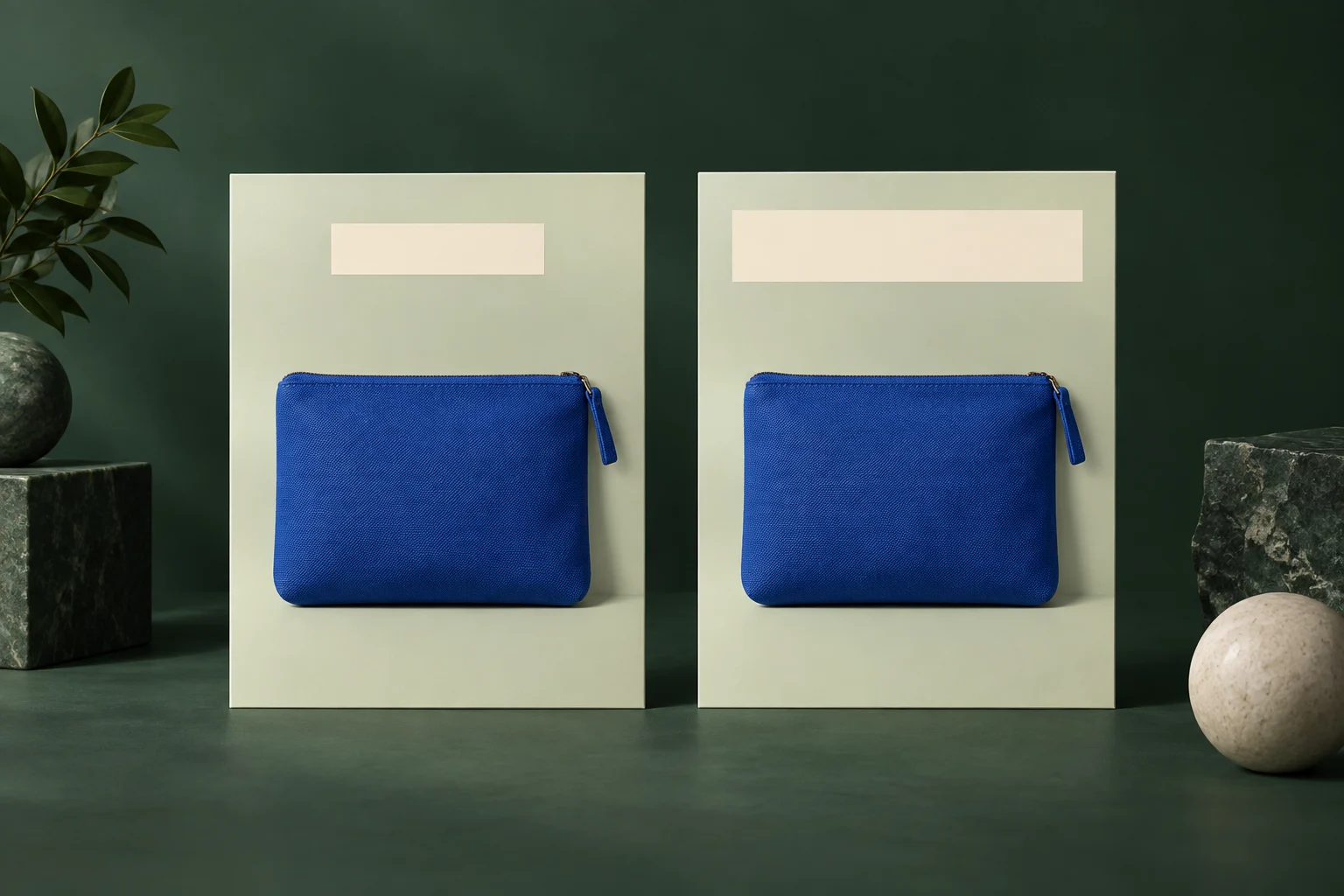
Here is a fictional assignment, not a Stage customer or reported campaign. The brand already has an agreed 24-second Arabic demonstration of a blue zip pouch. It wants two exports with different on-screen text during the first three seconds. The duration and timing are example production choices, not universal advertising recommendations.
Fictional comparison: only the opening text changes
Scroll sideways to see all columns.
| Part | Variant A | Variant B |
|---|---|---|
| First on-screen line | وين تحط أغراضك الصغيرة؟ — Where do you put your small items? | حقيبة بسحّاب لأغراضك الصغيرة — A zip pouch for your small items |
| Exact export | pouch-ar-hook-a-v01.mp4 | pouch-ar-hook-b-v01.mp4 |
| Opening picture and sound | Same pouch footage and same audio | Same pouch footage and same audio |
| Text treatment | First three seconds; agreed font, size, position and style | First three seconds; same font, size, position and style |
| Rest of the video | Same edit, product details, captions and call to action | Same edit, product details, captions and call to action |
The English explanations above translate the two Arabic lines for the reader; they are not extra text to add to the exports. Preview both actual Arabic lines at the agreed font size and ensure they fit the same text area without covering the product. If either requires a different layout, revise the pair before the test and record the final strings. Do not change the spoken opening as well: that would broaden the treatment beyond on-screen wording.
Agree the cost, revisions, two-export delivery and permissions for the intended paid use before commissioning the work. Testing is not a reason to request unlimited free variants. Keep the approved file versions with the experiment record so a later replacement cannot silently become part of the same comparison.
Separate creative preparation from experiment setup
TikTok’s split-testing guidance describes two equal audience groups, each seeing only one ad group, while other variables stay the same. Its best-practice guidance calls for a prior hypothesis, enough budget and time for the chosen test, and avoiding changes during the test. Use the current setup guidance for the advertising platform and account you actually use; a worksheet does not create that experiment for you.
- Choose the supported creative-testing setup and verify that only these two intended variants are being compared.
- Keep the audience definition, objective, destination, offer and other distribution settings the same except for the deliberate treatment. Follow the experiment tool’s allocation rules.
- Select a primary metric that the chosen experiment supports and that matches the decision. Record its exact platform name and definition before launch.
- Record the planned budget, duration, start/end time and time zone using the tool’s guidance and your constraints. Do not invent a universal minimum from someone else’s campaign.
- Check that required measurement works and the destination is the same for both variants. If essential setup or data is missing, resolve it before spending.
Publishing A on Monday and B on Friday changes timing and potentially who sees the video. Likewise, ordinary parallel ads are not automatically a controlled split test. Such observations may suggest a future hypothesis, but label them as observations instead of attributing the difference to the opening line.
Keep this test brief beside the production brief
Decision we want to make:
Hypothesis and tested audience:
Only variable changed: opening on-screen wording
Final line A and exact export:
Final line B and exact export:
Elements held fixed: footage, audio, edit, text treatment, CTA
Platform and supported experiment setup:
Objective and primary metric: exact name and definition
Destination, offer and distribution settings:
Budget, planned duration, start/end and time zone:
Measurement checks and person responsible:
Rule for reading the result at the planned end:
What we will do if the result is inconclusive:
Any interruption or change, with time and reason:
Fill in the metric and decision fields before launch. Diagnostic measures can explain what to investigate next, but do not switch the winning criterion after seeing which number favors your preferred version. If a tracking failure, wrong file or necessary change interrupts the experiment, record it and follow the platform’s guidance; do not present the interrupted run as the original clean comparison.
Make room for “no winner”
TikTok’s results guidance explicitly includes “No winning ad group found” and bases the reported winner on the key metric selected at the start. A small visible numerical difference is therefore not a substitute for the experiment’s result. Review that result and any validity warnings using the platform’s current explanation.
Suppose the fictional pouch experiment finishes as planned and the tool reports no winning ad group. The useful conclusion is that this run did not establish a winner on its selected metric. It does not prove the two lines are identical, that questions never work, or that either creator failed. Keep the result and settings, and decide whether the remaining business question justifies a separately planned test.
If the platform does report a winner, record the exact comparison, metric and conditions with it. Use that evidence for the decision you defined, while avoiding a promise that the same opening will win on another product, audience or platform. A completed experiment can guide the next creative decision; it cannot guarantee sales or virality.
How this fits UGC Stage
UGC Stage is an application in development connecting brands and UGC creators. Its planned brand requests let you describe an assignment and review applicants. You can use the brief below to explain the two creative exports you want to commission, with the scope and intended usage agreed separately. Running the advertising experiment and interpreting its results remain the brand’s work; this guide does not describe a testing or ad-management feature in the application. Join the brand launch list to hear when UGC Stage becomes available.
Explore the applicationSources and notes
Practical guidance from the UGC Stage team. Examples are educational, not customer results or income guarantees.