

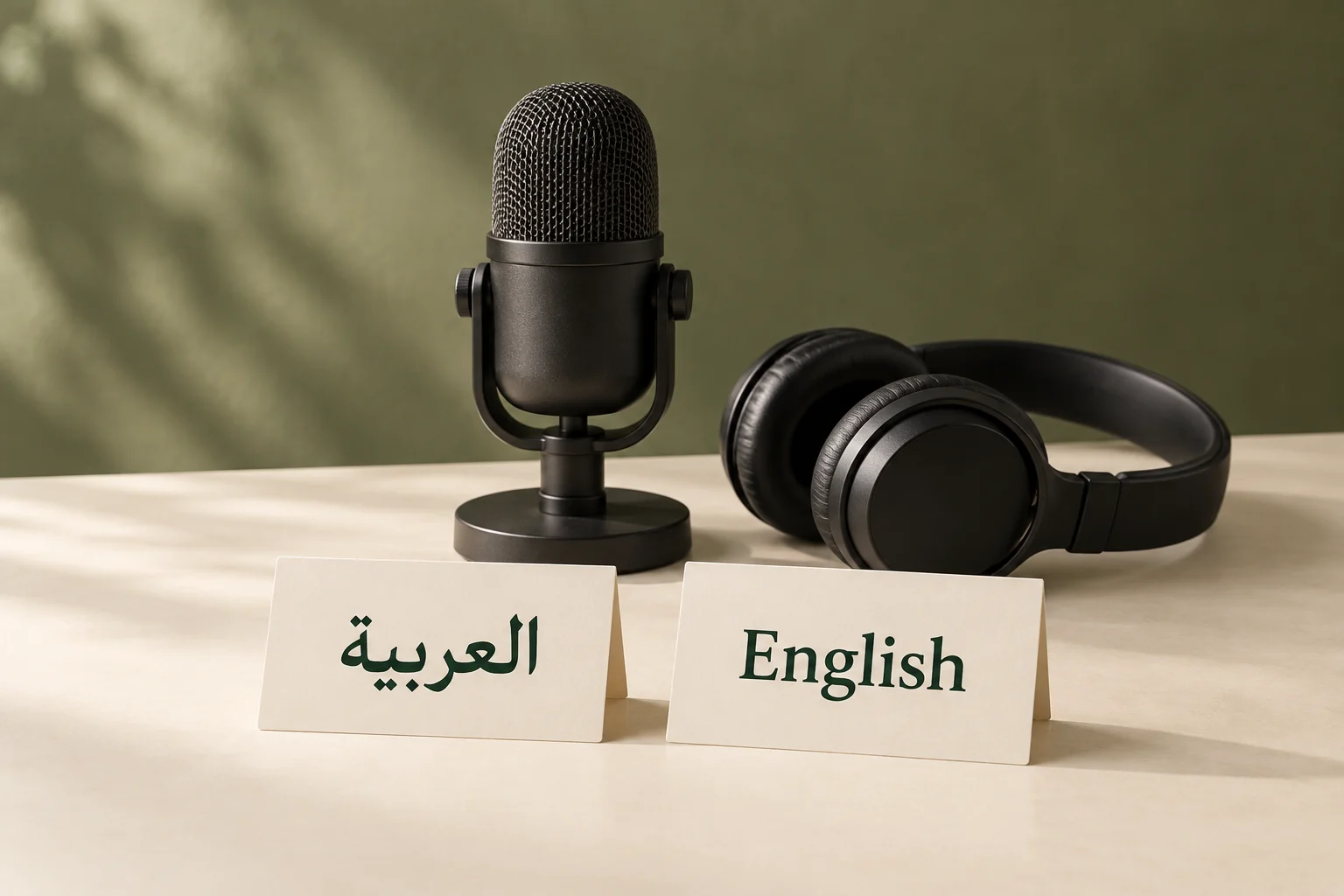
Before asking for an “English version,” say whether you want English speech, English subtitles over the original Arabic speech, or both. Then specify added labels, footage changes and the files you expect. A language name alone does not define the production work or the viewing experience.
Separate what the viewer hears from what they read
Translated subtitles can make Arabic speech readable in English while the Arabic voice remains audible. A newly recorded English voiceover changes the spoken track. An English heading added to the picture changes another layer again. None of these choices automatically translates text physically printed on the product.
YouTube’s multi-language documentation illustrates the distinction: creators supply their own dubbed audio tracks, while captions are handled separately. Its automatic-dubbing feature is a different route. These are YouTube features with their own availability requirements, not universal delivery options or Stage capabilities. Your brief should name the files and playback arrangement for the actual destination.
Language choices to resolve for each requested version
Scroll sideways to see all columns.
| Layer | Decision to write down |
|---|---|
| Spoken audio | Language and relevant dialect or speaking style; retain the existing recording or commission a new one. |
| Speech represented as text | Target language; same-language captions or translated subtitles; embedded in the picture or a separate selectable track. |
| Added visual text | Which headings, action labels and ending text change, and the agreed wording. |
| Footage and physical product text | Which shots remain suitable; any printed name, label or packaging detail that needs a decision. |
| Delivery | Exact number of video exports and any separate audio or subtitle files that are actually included. |
Example: two deliberately requested outputs
Imagine a brand commissioning a manual pencil-sharpener demonstration with product footage and voiceover, without a person speaking on camera. The invented brief requests both outputs below. They are two deliverables, not interchangeable interpretations of one “English version.” No recording or translation test was performed for this example.
Fictional language map for the same demonstration
Scroll sideways to see all columns.
| Decision | Output A | Output B |
|---|---|---|
| Spoken track | Retain the recorded Arabic voiceover | Record a separate English voiceover |
| Speech text | English translated subtitles embedded in the video | English same-language captions embedded in the video |
| Added action label | English: “Turn the pencil” | English: “Turn the pencil” |
| Picture | Same agreed product footage, if its visible details remain suitable | Same agreed product footage, if its action fits the new voiceover |
| Agreed export | sharpener-ar-voice-en-subs-v1.mp4 | sharpener-en-voice-en-captions-v1.mp4 |
For the fictional Arabic line «أدير القلم ببطء.» (“I turn the pencil slowly.”), A shows that English translation while preserving the Arabic voice. B uses an English recording expressing the same action, with captions checked against that actual recording. If the English recording is worded differently, its captions should follow what is spoken without changing the intended meaning.
The example requests two edited video exports only. Separate subtitle files, isolated audio and editable projects are not included in this invented scope. If you need one of them, ask for it explicitly and agree the change. The generated cover represents language planning; its printed cards do not prove that a translation or voiceover has been reviewed.
Resolve wording and picture together
Provide verified product names and explain words that should retain their original form. Specify the Arabic dialect or style when it matters to the assignment, and identify who can answer pronunciation questions. “Natural English” should not become permission to add a stronger product promise or personal experience absent from the original.
Review added labels separately from subtitles. A subtitle translates the spoken message; an action label may be a shorter instruction. They should not contradict each other or describe a different action. If the longer translated wording no longer fits the agreed shot, discuss a script or edit change rather than silently speeding up the voice or deleting important meaning.
For text printed on the physical product or packaging, decide whether the actual item remains suitable for the intended audience. Do not digitally invent a different label or variant. A translated explanation added beside the picture is a different choice from changing what the product itself appears to say; agree and describe that choice clearly.
Send a request the creator can confirm
For [audience and destination], we request [number] versions.
For each version:
Spoken language/style and retained or new recording: […]
Subtitle/caption language and embedded or separate delivery: […]
Added labels and ending text: […]
Footage retained or changed; physical text to resolve: […]
Exact exports and separate files included: […]
Who supplies wording and who reviews both languages: […]
Unresolved product terms or pronunciation: […]
Please confirm the work, timing, revision scope and any price change before production.
Use a blank or an explicit question where the decision is still open. If the original agreement covered only Arabic delivery, discuss the English work before treating it as an included correction. Do not assume one extra language always means one extra file: that depends on the layers and export choices you agree.
Review meaning, then the actual delivered combination
Have a reviewer who understands the relevant languages and product context compare the intended message across versions. Then listen to and read each final export together, checking product terms, the depicted action and the agreed text layers. A correct English transcript alone does not prove that the delivered video contains the right voice or subtitles.
YouTube warns that automatically generated dubs can contain errors involving pronunciation, accents, dialects, proper nouns, idioms and jargon. It documents preview and manual-review options. That is a reason to inspect generated audio if you choose to use it, not evidence that a reviewed track is guaranteed correct. The fictional example above uses a separately recorded voiceover and does not require an automatic dubbing service.
Record the exact version reviewed and any unresolved meaning or pronunciation question. For detailed caption timing and readability checks, use the related caption-review guide; for naming and transferring agreed exports, use the delivery guide. Approve the language combination you actually checked, rather than a file simply labeled “English.”
How this fits UGC Stage
UGC Stage is an application in development connecting brands and creators. Its planned brand requests let a brand describe the work and review creator applicants. A per-version language map can make that request more specific: the creator can see which spoken and written layers you need before discussing the assignment. Confirm language fit, who supplies and reviews the wording, and the agreed outputs directly; the map is a manual brief, not a promised translation or dubbing tool inside Stage. Join the brand launch list to hear when the application becomes available.
Explore the applicationSources and notes
Practical guidance from the UGC Stage team. Examples are educational, not customer results or income guarantees.