
Choose one product action, write what you can truthfully say about it, then check each line against the footage, your actual experience or reliable product information. Keep a precise description, narrow an overstatement and hold an unresolved claim before recording. A short demonstration can show what happened in that take; it cannot establish every benefit a script might promise.
Choose the action before the promise
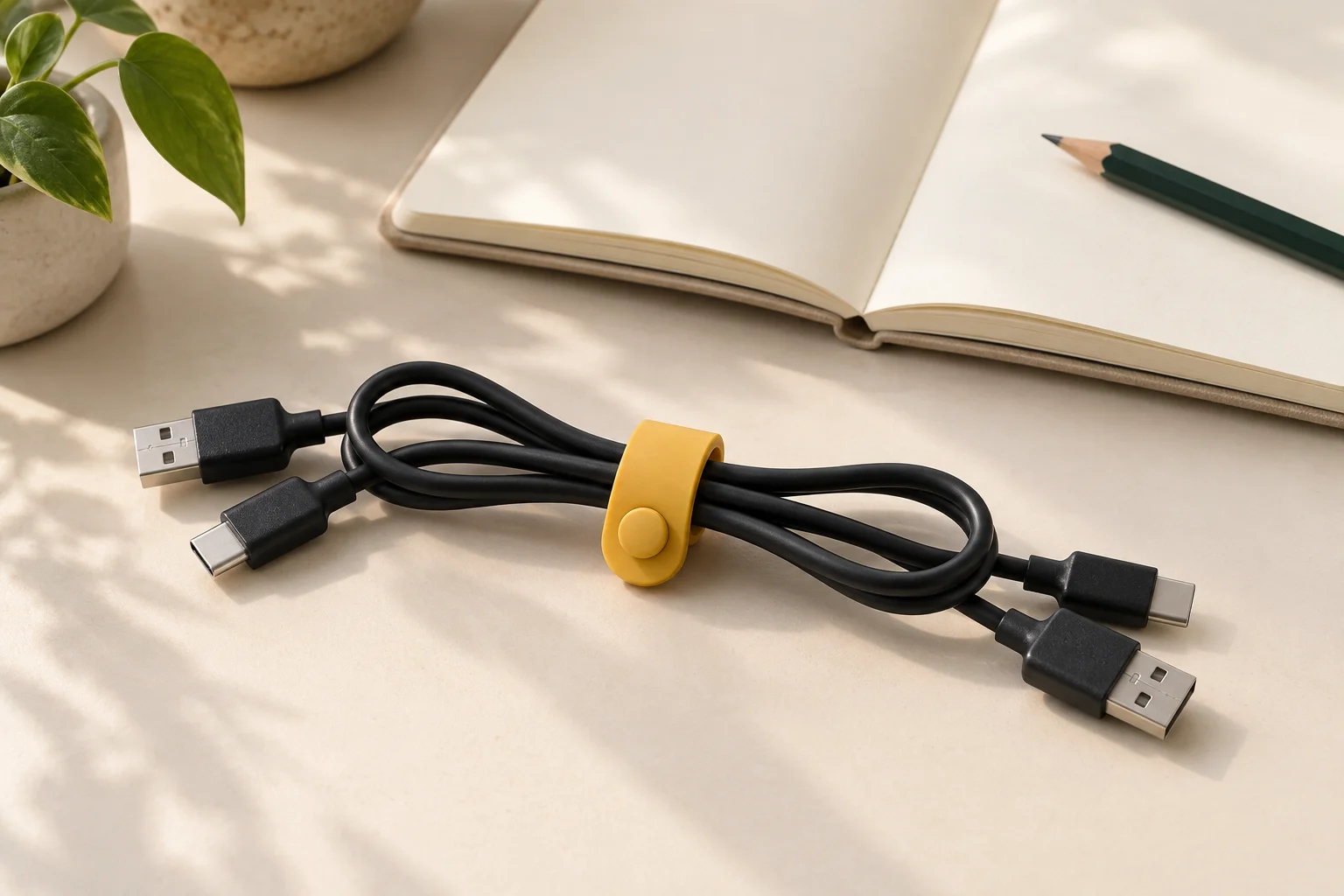
Start with the agreed task: what should a viewer understand how to do or see? For a fictional cable-organizer exercise, the task is fastening two loose cables together with a tie. It is smaller than proving that the product solves every desk-storage problem. Describe that action in plain words before adding a persuasive opening.
Write the line beside the moment that should accompany it. “I wrap the tie around these two cables” needs that action to be visible. “I have used it for a year” needs truthful personal history; a close-up of the tie cannot supply it. A wider compatibility or durability statement needs appropriate product information beyond this single demonstration.
The US Federal Trade Commission’s influencer guidance warns against discussing experience with a product you have not tried or inventing claims requiring proof the advertiser lacks. This is US guidance, not a statement of Saudi advertising law. The practical writing habit here is to separate what happened, what you actually know and what still needs confirmation.
Decide what to retain, narrow or hold
The following proposed lines and decisions are invented for this writing exercise. They are not observations from a product test, customer quotes or specifications for a real tie. For actual work, check the real product, the agreed brief and the basis for the exact wording.
Fictional say, show and check worksheet
Scroll sideways to see all columns.
| Proposed line | What would support it? | Writing decision |
|---|---|---|
| “I fasten the tie around these two cables.” | The chosen take clearly shows that action with those cables. | Retain only if it describes what actually happens in the footage. |
| “It fits every cable.” | Information supporting that universal scope; one pictured bundle does not establish it. | Narrow to “Here, I use it to gather these two cables,” if that is what the take shows. |
| “It will never come undone.” | Relevant durability information and conditions; a brief closed-tie shot is insufficient. | Hold the promise. Ask for clarification or remove it rather than infer long-term performance. |
| “I have relied on it for a year.” | The creator’s actual experience over that period. | Remove if untrue. Describe the present demonstration instead of inventing a history. |
Keep the three decisions separate. Narrowing changes the meaning to something you can support; it does not prove the original statement. Holding means the line is unresolved and should not be recorded as an established fact. Adding “I think” or “I feel” does not repair an invented experience or quietly preserve the same unsupported promise.
A brand’s approval of a script is not, by itself, evidence that a statement is true. Ask for the relevant product information and the intended limits of a claim. If the wording remains unresolved, agree on a truthful alternative or leave it out. A clear sponsorship disclosure would not make a false product statement accurate either.
Read the words while doing the action
Here is a possible short script for the fictional exercise. Use it only as a writing example, adapting every line to the actual action. There is no required duration or word count.
Fictional cable-organizer demonstration
Start, with two loose cables visible: “I want to keep these two cables together.”
While wrapping the tie: “I wrap this tie around them and fasten it.”
With the fastening visible: “Here is the bundle after fastening.”
Rehearse the words while performing the movement. If the action takes longer than the sentence, leave a natural pause or simplify the shot. If the narration says “fasten” while the fastening is out of frame, change the framing or the line. Do not solve that mismatch by speeding through the only detail the viewer needs.
Read aloud in the intended language rather than copying written advertising phrases that you would never naturally say. Keep the meaning consistent when adapting Arabic and English: “these two cables” must not become “all cables” in translation. If a demonstration fails, revise the plan or record a usable truthful take; do not edit a failed result into a supposed success.
Resolve open lines before filming them
Send a focused question for an unresolved line instead of a vague request to approve the whole script. Include the exact sentence, what the planned footage can show and the alternative you propose. A creator can ask for clarification without pretending to certify whether evidence satisfies every applicable rule.
Script clarification
Proposed line: “It fits every cable.”
Our planned demonstration: fastening these two selected cables.
Unresolved point: the footage does not establish universal compatibility.
Question: what product information and conditions support the intended claim?
Suggested alternative: “Here, I use it to gather these two cables.”
Decision and agreed wording:
Information or condition still needed:
Script version and corresponding shot:
- Before recording, check that every spoken claim has an identified basis and that unresolved lines are clearly held back.
- After recording, compare the chosen take with the exact script. Recheck any improvised sentence as carefully as a written one.
- Read added captions and on-screen text for broader claims that the voiceover never made.
- Keep the agreed script version with the chosen footage. If the product, action or wording changes, revisit the affected lines.
This worksheet addresses script meaning. Disclosure, permission and market-specific advertising requirements still need their own appropriate review for the assignment. Finish with a demonstration you can explain accurately, without treating confident delivery, attractive footage or a signed-off script as proof of a broader result.
How this fits UGC Stage
UGC Stage is an application in development connecting creators and brands. Its planned portfolios let you show selected video, photo and audio work. A self-initiated product demonstration can show how you turn an action into clear narration and make careful script decisions. Label it as a practice sample, describe your actual role and use material you are allowed to show. Prepare the script with your own writing and filming tools; a portfolio sample is not evidence of a client relationship or campaign result. Join the creator launch list to hear when the application becomes available.
Explore the applicationSources and notes
Practical guidance from the UGC Stage team. Examples are educational, not customer results or income guarantees.