
Before asking a creator to “show the size,” decide what the viewer needs to learn. Seeing a product beside a notebook, reading its dimensions and watching that notebook fit inside answer different questions. Assign the evidence for each question before filming, then keep the final wording within what the actual item and recording support.
Choose the size question before the shot
Start with a concrete question: how large does this basket look on a desk, what are its verified dimensions, or can this particular notebook lie flat inside? Do not replace all three with “make it look spacious.” The brand should identify the actual product variant and supply confirmed information needed for any numerical statement.
Shopify’s ecommerce-photography guide describes lifestyle images as showing a product in use or context so shoppers can gauge its size. That supports using context as an explanation. It is photography guidance, not a measurement standard or proof that a particular object will fit. The commissioning method below is an editorial planning tool.
Name the comparison object precisely. “Notebook” and even “pocket notebook” do not specify one universal size. Record the actual notebook or its product reference, and obtain its dimensions if the message depends on them. Also state whether it is included with the basket; a demonstration prop must not quietly become an implied part of the purchase.
Give context, dimensions and fit separate evidence
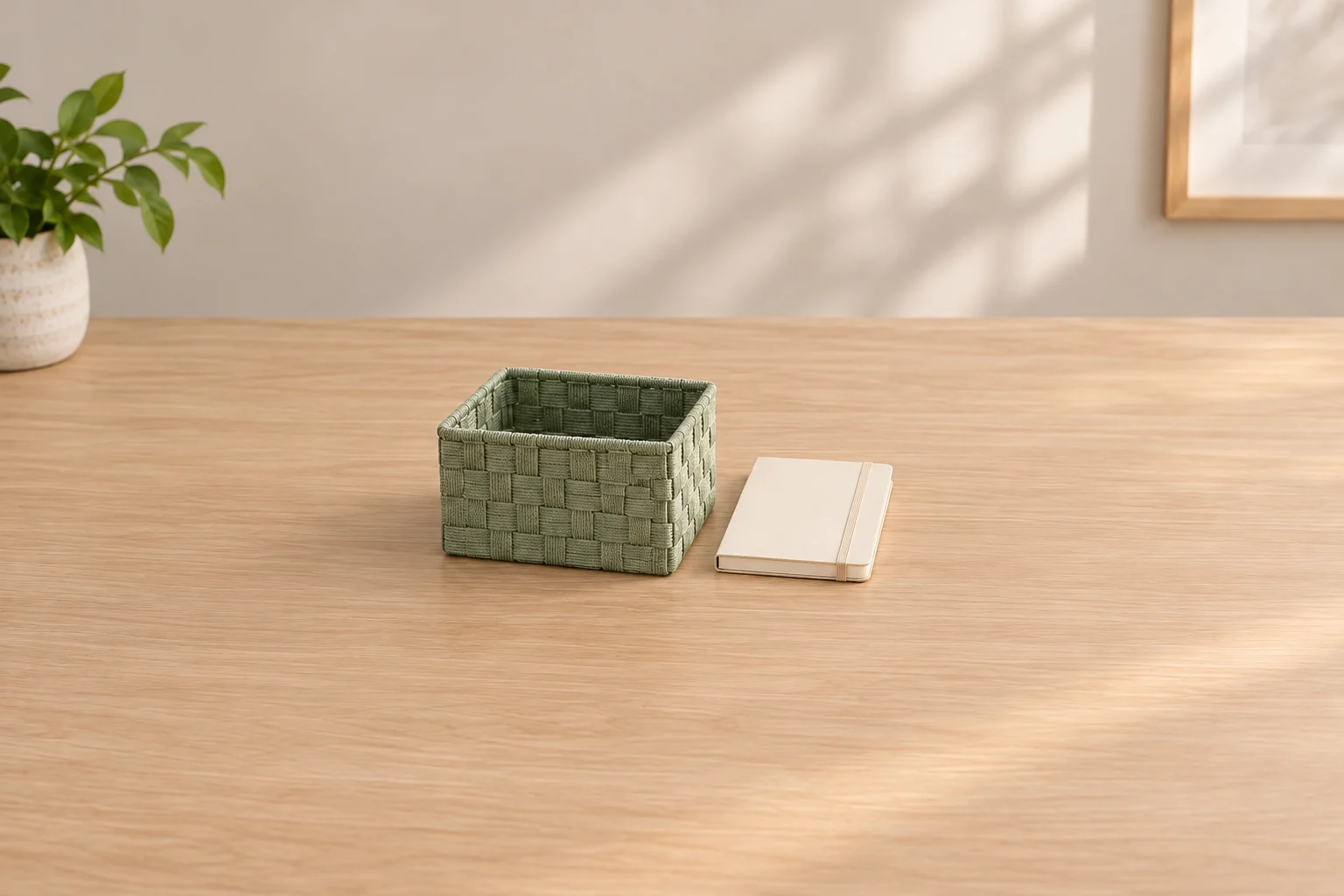
Imagine a fictional sage desktop basket sold without accessories. A cream notebook is a separate demonstration prop. The proposed video must explain the basket’s appearance on a desk and whether that specific closed notebook can lie flat inside. No capture or measurement has been performed for this example.
Fictional size-evidence assignment
Scroll sideways to see all columns.
| Viewer’s question | Evidence to arrange | Boundary for wording |
|---|---|---|
| How large does it look beside this object? | Show the actual basket and identified notebook together, with both complete and their placement clear. | Describe the visible comparison. Do not turn it into an exact measurement. |
| What are its dimensions? | Obtain confirmed measurements for this variant, with units and a clear indication of what was measured. | Distinguish exterior dimensions from usable interior space. Do not estimate a number from the image. |
| Can this notebook lie flat inside? | Arrange a real placement attempt with the specified closed notebook; show its final position and relevant basket edges. | Describe only the observed fit of that item in that position. Do not extend it to all notebooks or total capacity. |
Agree the intended position before shooting: lying flat is a different request from standing upright or resting diagonally. Ask for a view that reveals whether the notebook reaches the base and whether it has been bent or forced. If the required evidence cannot be seen, plan another view rather than treating an attractive angle as sufficient.
The generated cover illustrates two separate objects. It does not show a fit attempt, verified dimensions or the actual products in this fictional assignment. Use the real item and reference object for any commissioned demonstration.
Repair the message that the shot cannot support
Suppose a hypothetical edit shows the notebook beside the basket while its narration says, “Fits all your notebooks.” The picture supplies context, but no placement evidence; the claim also reaches beyond the specified notebook. A larger close-up of the basket does not resolve either problem.
Choose the next action according to the agreed purpose. If the video only needs size context, replace the broad promise with an accurate description of the comparison. If the agreed demonstration requires the notebook lying flat inside, request the missing attempt and final-position view. Confirm any additional work before changing scope or delivery timing.
After an actual successful attempt, wording such as “This notebook lies flat inside” may describe what is shown. If it does not fit, record that outcome and revise the message or demonstration plan. Do not substitute a smaller notebook without identifying the change. Do not resize the basket independently of the reference object in editing to manufacture the desired relationship.
Check narration, visible text and the final picture together. Removing an overbroad text label does not repair the same promise still spoken in the audio. A caption giving exterior width also cannot establish the usable opening or interior fit.
Keep the agreed question beside the reviewed file
Use this short record before commissioning. Fill the observation and filename fields only after reviewing the actual export. Keep missing information visible instead of marking a planned capture as completed.
Product-size evidence record
Actual product and variant:
Question the viewer should be able to answer:
Comparison object and whether it is included:
Confirmed dimensions, units and information source, if required:
Required position or action:
Evidence still missing and responsible person:
Agreed spoken and visible wording:
Exact file/version reviewed and scene reference:
What the actual recording shows:
Remaining correction and next action:
Revisit the affected row if the product, notebook, position or wording changes. The finished record should distinguish a visual impression, confirmed dimensional information and an observed fit. That gives the creator a specific task and the brand a clear basis for checking the delivered message, without promising a particular sales result.
How this fits UGC Stage
UGC Stage is an application in development connecting brands and creators. Its planned workflow will keep conversations, references, files and feedback in one place. A manual size-evidence record can keep the agreed comparison object, confirmed product information and unresolved filming questions beside the brief. Prepare and verify that record with your own production tools; the application is not a promised measurement or automatic product-verification service. Join the brand launch list to hear when it becomes available.
Sources and notes
Practical guidance from the UGC Stage team. Examples are educational, not customer results or income guarantees.